A GENERATIVE AI SHORT FILM / A PRODUCTION CASE STUDY
The Wolf &
Little Red.
Everyone knows who the monster is.
Everyone is wrong.
From story to screen
One fairytale.
Seven stages of craft.
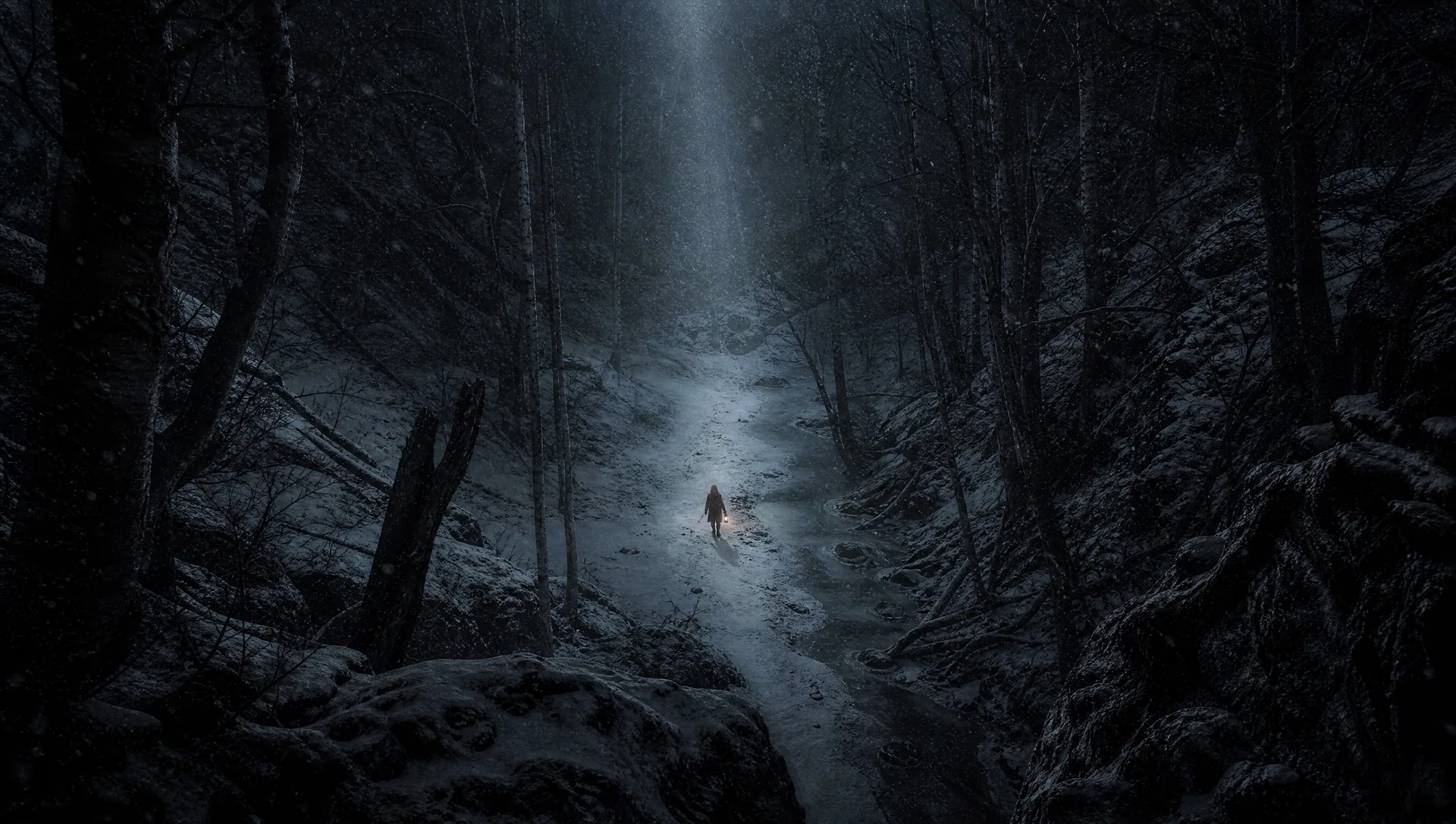
A giant wolf stalks a girl in a red cloak through a black winter forest, and every instinct says he is the predator. He isn’t. He has been hunting her to stop her from reaching Grandmother’s house.
A dark retelling of the public-domain Little Red Riding Hood, built as a cinematic teaser. Every character, set, and shot was designed and directed first, then generated: story, visual development, storyboards, hero frames, animatic, image-to-video shot production, edit, and sound.
01 / STORY
Use the story they know
against them.
The audience walks in already knowing this fairytale. The film leans on that: every beat reads as a predator hunting prey, until the last shot reveals who the real threat was.
The hunt.
A red cloak moves through a dead forest. Amber eyes open in the dark. The wolf paces her along the ridge, then breaks cover and charges.
The escape.
She falls. He towers over her. A lantern to the face, and she runs for the one warm window in the woods. He throws himself at the door.
The refrain.
Firelight. A shape in the bed. Each answer comes slower than the last.
“Grandmother… what big teeth you have.”
“All the better…”
The flip.
The wall explodes inward. The wolf goes past Red, straight for the thing in the bed.
The storytelling decisions
Clues hiding in plain sight.
The wolf tears down the bone markers on the path. Claw marks are on the outside of the cottage door. A hunter’s axe and boots lie half-buried by the steps. Grandmother’s hand on the quilt is grey and far too long. Every clue plays as menace the first time and as warning the second.
One color, one warmth.
Red’s cloak is the only saturated color in the film, and fire is the only warm light. The audience’s eye goes exactly where the story needs it.
Never show the monster clearly.
Grandmother stays in silhouette, rim light, and fragments. What the audience imagines is worse than anything on screen.
02 / VISUAL DEVELOPMENT
Lock the world
before the first shot.
Characters, sets, props, and a style board were explored in options, then locked as a reference library. Every later image and video generation was anchored to these designs to keep the film consistent from shot to shot.
03 / STORYBOARDS
Plan every lens,
every move.
Two pages of clean line boards cover all 18 shots, each labeled with lens, shot size, camera move, and duration. Wides stay low and still, tension comes from slow push-ins, and terror from long lenses. Select a page to inspect it.
04 / HERO FRAMES
Design the image,
then make it move.
Each board became a finished hero frame, built from the locked characters, sets, and style guide. These frames are the start images for every generated shot, so composition, lighting, and performance are decided here, not left to chance.
05 / ANIMATIC
Find the rhythm
before the render.
The hero frames were cut together in Premiere Pro with timed push-ins and fades. The animatic set the length of every shot, which then set how long each generated clip needed to be.
06 / SHOT PRODUCTION
Direct the shot,
not the slot machine.
Each hero frame became the start image for an image-to-video generation in Seedance 2.5, with Kling 3.0 for the shots that needed another approach. Every prompt specified camera, timing, and performance, and shots were re-run until the action cut cleanly. A few of the final takes:
Compare each take with its hero frame above: the frame locks composition and lighting, and the prompt adds the motion, the camera move, and the beat the edit needs.
07 / FINAL FILM + SOUND
Bring it all together.
The final edit, with sound design and mix, brings the story, designs, boards, frames, and generated shots into one 1:22 film. Play with sound on.
Generative tools. Directed results.
Story clarity, locked designs, planned cameras, and an edit that serves the twist. This is how I bring generative AI into real production.
Let’s build something together ↗See the Five Minutes Late breakdown ↗